Think about your weekly routine. You probably visit the grocery store, hit the gym, go to work, or drop the kids off at school. You likely know where the restrooms are, where to park, and maybe even where the fire extinguishers are located.
But do you know where the nearest AED is?
An AED, or Automated External Defibrillator, is a medical device designed to analyze the heart rhythm and deliver an electrical shock to victims of ventricular fibrillation to restore the heart rhythm to normal. It is one of the most critical tools in the chain of survival for sudden cardiac arrest. Yet, despite their life-saving power, they are vastly underutilized.
The 12% Problem
The statistics are sobering: Less than 12% of individuals who experience a cardiac arrest in public have a bystander-applied AED. Why is this number so low? When every second counts, the reasons usually boil down to two main factors:
- Fear of doing harm: People are afraid they will shock someone who doesn’t need it or use the machine incorrectly.
- Invisibility: In the chaos of an emergency, bystanders simply don’t know where the AEDs are located in the building.
Busting the AED Myth
Let’s address the fear right now: You cannot accidentally shock someone who doesn’t need it. Modern public access AEDs are incredibly smart and designed specifically for use by untrained bystanders. Once you turn the machine on, a calm, clear voice will give you step-by-step instructions. It will tell you exactly where to place the pads. It will analyze the patient’s heart rhythm on its own. If a shock is not needed, the machine will not deliver one, even if you press the button.
Your only job is to grab it, turn it on, and listen.
The Tri-Cities Awareness Challenge
Because AEDs are so easy to use, the biggest hurdle we face in the Tri-Cities is simply knowing where they are before an emergency strikes. When someone collapses, you do not have minutes to spare searching the hallways.
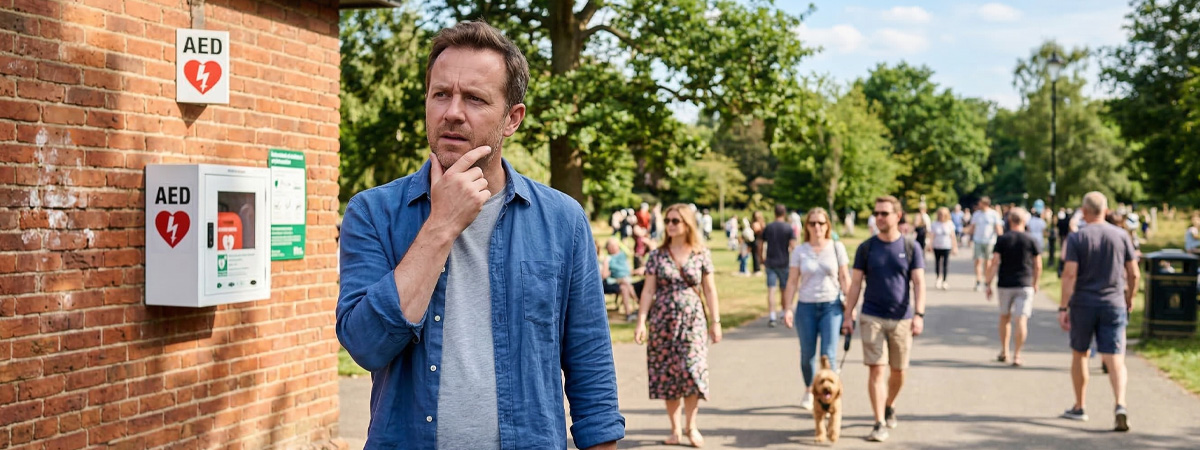
This month, we are challenging you to a life-saving scavenger hunt. Next time you are out and about in our community, consciously look for the AED.
- What to look for: They are usually housed in white or clear wall cabinets, marked with a red heart and a lightning bolt.
- Where to look: Check near the front entrances of grocery stores, near the front desks of gyms, in school hallways, and in the lobbies of office buildings.
Make a mental note. Tell your family where it is. By simply being aware of your surroundings, you are preparing yourself to be the vital link in the chain of survival.
Sudden cardiac arrest doesn’t wait for the paramedics to arrive. It requires immediate, on-the-spot action. Be the spark that saves a life. Look up, look around, and find the AED.